UN Manual of Tests and Criteria Rev.8 (2023) and Amendment 1 to Rev.8 (2025)
ID 24590 | 15.09.2025 / Attached
Published: September 2025
In December 2024, at its twelfth session, the Committee adopted a set of amendments to the eighth revised edition of the Manual (see ST/SG/AC.10/52/Add.2). These amendments address mainly:
- Changes to sections 11, 12, 18 and 25 and a new appendix 12 addressing Koenen tube test specifications and test procedures; - Changes to section 31 for alignment of the definitions of flammable components and heat of combustion with special provision 63 in the Model Regulations; - Changes to subsection 38.3 addressing lithium cells and batteries and the definition of rupture; - The review of sub-section 51.4 for further improvement of the burning rate test criteria and method of assessing results; and - A new section 42 containing a test method to prove the fire resistance of fibre reinforced plastics service equipment for portable tanks.
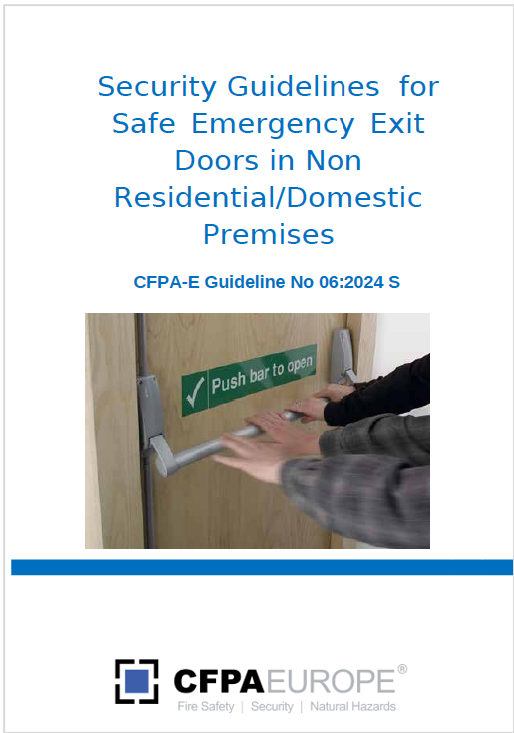
Emergency Exit Doors in Non Residential/Domestic Premises / CFPA 2024
ID 24585 | 14.09.2025 / CFPA-E Guidelines No 06:2024
The document assists specialists and end users in selecting suitable means to secure buildings against intrusion via emergency exit doors. They relate to commercial and public premises only and relates specifically to emergency exit doors. Windows and other openings are outside the technical scope of this document.
Contents Introduction 2 Scope 3 Principles 3.1 General 3.2 Risk assessment 3.3 Ease of escape 3.4 Management systems 4 Security considerations 4.1 Construction of emergency exit doors 4.2 Security hardware for emergency exit doors 4.2.1 General requirements 4.2.2 Small business, stable workforce, no public areas 4.2.3 Larger businesses and/or public access 4.3 Door bolts for emergency exit doors 5 Additional security vulnerabilities 5.1 Glazing in, or adjacent to, doors 5.2 Letter plate openings 5.3 Hinge bolts 6 Enhanced security 6.1 General 6.2 "Drop-in" bars 6.3 Padlocks 6.4 Grilles, gates and shutters 6.5 Intruder alarm systems 6.5.1 Local door alarm devices 6.5.2 Premises intruder alarms 6.6 VSS 6.7 Access control/building management systems. European guidelines
5. Norma riconosciuta a livello internazionale: norma adottata da un organismo riconosciuto a livello internazionale.
Nota Sono organismi riconosciuti a livello internazionale tutti gli organismi di normazione extra europei citati nel presente documento e quelli comunque tradizionalmente riconosciuti nel settore antincendio. Ad esempio: NFPA, ANSI/UL, ASTM, API, FM Global, FPA, NIST, SFPE, TNO, VDS, Energy Institute, IGEM, VTT, BRANZ, … ...
S.5.9 Riferimenti
1. Si indicano i seguenti riferimenti ...
d. European guideline CFPA-E No 1:2014 F “Fire protection management system”.[/box-info]
Recipienti per uso domestico (bombole ricaricabili) / Relazione finale JACOP 2024
ID 24502 | 30.08.2025 / In allegato
Questa attività si è concentrata sui recipienti (bombole ricaricabili) per uso domestico, in particolare sui recipienti in acciaio saldato contenenti GPL e sui recipienti in materiale composito contenenti GPL, che sono stati identificati dalle AVM come una priorità per un’indagine di sicurezza mirata. Le prove sono state condotte secondo le norme EN 1440:2016+A1:2018+A2:2020 (acciaio) e EN ISO 11623:2015 (composito).
L’iniziativa JACOP mira a organizzare azioni congiunte sulla conformità dei prodotti nei Paesi dell’UE e dell’EFTA, promuovendo la collaborazione tra le Autorità di vigilanza del mercato (AVM). Tra gli obiettivi principali figurano la conduzione di prove congiunte sui prodotti, la valutazione dei rischi e l’armonizzazione delle metodologie operative. Attraverso dialoghi aperti, condivisione di conoscenze e coinvolgimento di attori esterni, il progetto contribuisce a creare un mercato unico sicuro. I punti chiave sono la valutazione dei rischi di prodotto, l’attuazione di misure tempestive e l’allineamento normativo.
Queste JACOP 2024 hanno testato 16 recipienti in acciaio e 3 in materiale composito. Su 16 recipienti in acciaio testati, il 44 % non ha superato almeno una prova (7 campioni). Dei 3 recipienti in materiale composito testati, un campione non ha superato il test. I principali problemi individuati riguardavano le condizioni esterne e interne dei cilindri e l’integrità delle valvole.
L’analisi di 19 campioni secondo le norme EN 1440:2016+A1:2018+A2:2020 e EN ISO 11623:2015 ha dato i seguenti risultati:
- Per la norma EN 1440:2016+A1:2018+A2:2020, 7 campioni non hanno superato l’ispezione visiva (5.2) e la verifica delle condizioni interne della bombola (5.4) e la prova di pressione idraulica (5.3.2) a causa di problemi quali ammaccature e crepe nell’anello del piede, oltre a profonde tacche e ammaccature. Si è riscontrata una corrosione lungo la giunzione tra l’anello di base e la bombola e una notevole corrosione e alterazione dell’aspetto superficiale, nonché corrosione all’interno dei recipienti;
- Per EN ISO 11623:2015 tutti i campioni hanno superato la prova, tranne uno, che non ha superato l’ispezione della valvola (11) a causa della corrosione.
____________
Indice
Elenco delle abbreviazioni
Parte 1
Obiettivi dell’attività Risultati e conclusioni Raccomandazioni chiave Panoramica dell’attività AVM partecipanti Ambito di applicazione del prodotto Criteri di prova Campionamento e prove Panoramica dei prodotti nel campione e dei canali di campionamento Processo di prova Risultati delle prove Panoramica dei risultati delle prove e conclusioni e principali Risultati per clausola di prova Valutazione del rischio e misure Valutazione del rischio e misure Conclusioni e raccomandazioni Conclusioni Raccomandazioni per le parti interessate
Parte 2
JACOP 2024 comprende 16 attività specifiche per prodotto che coprono 9 settori Ruoli e responsabilità Piano di lavoro e tempistiche Strumenti e processi Strumenti Canali
Piano nazionale per la ricerca dei residui (PNR) - Risultati anno 2024
ID 24503 | 30.08.2025 / In allegato
Il Piano Nazionale Residui (PNR), che prevede controlli sui prodotti di origine animale nella fase di produzione primaria o nella prima trasformazione, viene predisposto annualmente dal Ministero della salute sulla base delle indicazioni previste dalle norme europee e viene attuato a livello locale grazie alla collaborazione delle Autorità competenti regionali e locali, degli Istituti zooprofilattici sperimentali e del Laboratorio nazionale di riferimento.
Oggetto di indagine del Piano è la ricerca delle sostanze farmacologicamente attive vietate o non autorizzate (Gruppo A) e quelle autorizzate nei medicinali veterinari (Gruppo B), al fine di evidenziare, nel processo di allevamento degli animali, eventuali usi illeciti/impropri o verificare il corretto uso di tali sostanze.
In linea generale il sistema italiano ha fronteggiato in modo estremamente efficace il cambiamento delle procedure conseguenti alle nuove norme, grazie sia al coordinamento puntuale e costante tra gli attori a tutti i livelli, sia al buon funzionamento del sistema informatico RaDISAN del Ministero della salute, implementato dal 2022, che ha permesso un monitoraggio quasi in tempo reale delle attività, consentendo interventi correttivi in corso d’opera.
Nell’ambito di tutte le attività del Piano Nazionale Residui, nel 2024 sono stati prelevati 26.968 campioni (per un totale di 397.913 determinazioni analitiche): di questi 24.337 campioni sono stati prelevati nell’ambito del Piano mirato, 1.056 nell’ambito del Piano di sorveglianza, 429 nell’ambito del Piano Paesi terzi.
Oltre alle attività pianificate a livello nazionale, 514 campioni sono stati prelevati nell’ambito di Extrapiano nazionali e regionali, per approfondire particolari problematiche, e 632 campioni sono stati prelevati su sospetto. I campioni non conformi sono stati in totale 38 e l’andamento delle non conformità è risultato in linea con i risultati degli ultimi anni, con percentuali di irregolarità leggermente inferiori rispetto a quelli registrati in ambito comunitario.
Deliberazione 18 gennaio 2022 15/2022/R/rif - TQRIF
ID 24500 | 29.08.2025
Regolazione della qualità del servizio di gestione dei rifiuti urbani
Il provvedimento adotta il Testo unico per la regolazione della qualità del servizio di gestione dei rifiuti urbani (TQRIF), prevedendo l’introduzione di un set di obblighi di qualità contrattuale e tecnica, minimi ed omogenei per tutte le gestioni, affiancati da indicatori di qualità e relativi standard generali differenziati per Schemi regolatori, individuati in relazione al livello qualitativo effettivo di partenza garantito agli utenti nelle diverse gestioni.
Allegato A: Testo unico per la regolazione della qualità del servizio di gestione dei rifiuti urbani (TQRIF)
Allegato A: Testo unico per la regolazione della qualità del servizio di gestione dei rifiuti urbani (TQRIF) Versione integrata con le modifiche apportate con la deliberazione 374/2025/R/RIF
These recommendations are applicable to all laboratories. In addition to life safety, losses due to fire, explosion and ingress of water, intruders, and consequential losses are considered.
Health hazards and the reactions of chemicals, biohazards and radioactive materials are not considered in this document.
Also outside the scope of this document are clean rooms (areas with strictly controlled environmental conditions) which are situated within laboratory or manufacturing premises.
This publication provides recommendations to supplement national regulations for fire safety in laboratories of all sizes from small rooms to multi-million pound facilities. The guidance is directed to property protection and business continuity, as well as life safety issues. ...
Although laboratories differ widely in their construction and application, two general types of laboratory are encountered:
- Physicallaboratories are used for testing the size, shape, weight, strength, corrosion resistance, fire related properties and other physical and mechanical qualities of materials. - Chemical, pharmaceutical and bioscience laboratories where qualitative and quantitative analyses are undertaken to determine the composition of a material or product.
Generally, the hazards encountered in laboratories are low to moderate because of the relatively small quantities of materials being involved. However, some facilities may present serious fire hazards from:
- Excessive quantities of flammable or reactive chemicals; - uncontrolled ignition sources and - inadequate procedures or equipment for handling hazardous materials.
There is often a need for controlled conditions to achieve precise measurements and these can assist in reducing the hazards. As well as the life risk associated with fires and explosions in laboratories, many of these facilities will contain sophisticated equipment of high asset value and damage to these may have a significant impact on the continuing smooth running of the business operations of the organisation concerned or even those in neighbouring premises.
These factors should be addressed at the time of the outline fire risk assessment undertaken during the planning stage of the facility. As soon as the laboratory is operational a substantive fire risk assessment should be undertaken in accordance with national fire safety legislation. In order to maintain business continuity it is vital that in all laboratories an appropriate fire safety strategy is developed and adopted with staff receiving detailed instruction in the actions that they should take in an emergency. Incidents are thus measured not only in the direct material loss of the building and contents but in the loss of business earnings and productive time.
The replacement value of the building and its contents must be taken into account when considering measures necessary to address the fire risk assessment and not only the time necessary to construct or find new premises but the time necessary to duplicate research or production that has been carried out, in order to replace lost samples and essential data that will be needed before any new work can be undertaken.
A significant fire loss can seriously undermine international collaboration on projects and have an impact on marketing and hence the income to be derived from new products. A loss may also affect customers’ or potential future research partners’ perceptions of the organisation. The likelihood of an incident occurring must be minimised and if a fire does occur the quicker it is under control, the more likely it is that disruption to business will be minimised and normal operations will resume.
The general fire precautions should be the subject to a fire risk assessment in accordance with national legislation or practice. Where chemicals are present, an assessment may also need to be undertaken in accordance with relevant national legislation concerning the control and management of dangerous substances.
These assessments should be subject to periodic review and should always be reviewed at the planning stage of a new research project.
Other national legislation may also be relevant to the work being carried out in laboratories and appropriate action should be taken and recorded, including complying with such environmental legislation and controls as may be necessary.
This guideline is primarily intended for those responsible for safety in companies and organisations. It is also addressed to fire and rescue services, consultants, safety companies etc. so that, in course of their work, they may be able to help companies and organisations to increase their levels of fire safety. ...
Contents 1 Introduction 2 Scope 3 Definitions 4 Construction 5 Services and equipment 6 Space heating and air conditioning 7 Fume cupboards (including glove boxes) 8 Hot plates, ovens, furnaces and heating equipment 9 High-value equipment 10 Flammable liquids and gases 10.1 Piped services 10.2 Gas cylinders 10.3 Highly flammable and flammable liquids 10.4 Hazardous chemicals 11 Fire safety management 11.1 General provisions 11.2 Waste disposal 11.3 Welding and other hot-work processes 11.4 Overnight use 11.5 Smoking, eating and drinking 11.6 Water damage 12 Fire protection systems and training 13 Security 14 Contingency planning Annex 1: Checklist Inspection checklist European guidelines
5. Norma riconosciuta a livello internazionale: norma adottata da un organismo riconosciuto a livello internazionale.
Nota Sono organismi riconosciuti a livello internazionale tutti gli organismi di normazione extra europei citati nel presente documento e quelli comunque tradizionalmente riconosciuti nel settore antincendio. Ad esempio: NFPA, ANSI/UL, ASTM, API, FM Global, FPA, NIST, SFPE, TNO, VDS, Energy Institute, IGEM, VTT, BRANZ, … ...
S.5.9 Riferimenti
1. Si indicano i seguenti riferimenti ...
d. European guideline CFPA-E No 1:2014 F “Fire protection management system”.[/box-info]
Trasmissione documentazione concernente le attrezzature di lavoro rientranti nel decreto ministeriale 4 marzo 1982 e nell’Allegato VII del D.lgs. n. 81/2008 e s.m.i.
Come è noto il Decreto ministeriale 11 aprile 2011, nell’Allegato II, punto 5.4 “Disposizioni transitorie”, dispone che “Entro 3 mesi dall’entrata in vigore del presente decreto, il Ministero del lavoro e delle politiche sociali invia all’INAIL e alle ASL territorialmente competenti la documentazione in suo possesso, riguardante le attrezzature di lavoro rientranti nel decreto ministeriale 4 marzo 1982, rispettivamente ai fini della prima verifica periodica e delle verifiche periodiche successive alla prime.”
Al riguardo d’intesa con la Direzione Generale per l’Attività Ispettiva, su conforme parere della Commissione di cui al D.M. 11/04/2011, si chiede a codeste Direzioni Territoriali di trasmettere, nel più breve tempo possibile, l’intera documentazione relativa: – ai ponteggi sospesi motorizzati, – alle attrezzature speciali di cui al punto 9 dell’Allegato A del D.M. 04/03/1982 (compresi i carri raccogli frutta); alle sedi INAIL ex ISPESL, territorialmente competenti, nel caso di attrezzature mai sottoposte a verifica periodica o alle sedi ASL/ARPA, territorialmente competenti, nel caso di attrezzature già verificate.
Decreto-Legge 8 agosto 2025 n. 116 - Decreto Terra dei fuochi / Legge di conv. 147/2025
ID 24367 | 08.08.2025
Decreto Legge 8 agosto 2025 n. 116 Disposizioni urgenti per il contrasto alle attivita' illecite in materia di rifiuti, per la bonifica dell'area denominata Terra dei fuochi, nonche' in materia di assistenza alla popolazione colpita da eventi calamitosi.
(GU n.183 del 08.08.2025)
Entrata in vigore del provvedimento: 09/08/2025
In allegato - Testo del DL 8 agosto 2025, n. 116 coordinato con la Legge di conversione 3 ottobre 2025 n. 147 (GU n. 233 del 07.10.2025) - Decreto-Legge 8 agosto 2025 n. 116 (GU n.183 del 08.08.2025) - Schema DL Terra dei fuochi - 29.07.2025 - Comunicato stampa CdM del 30 luglio 2025 n. 137
______________
31.07.2025
Il Consiglio dei Ministri, riunitosi il 30 luglio 2025, ha approvato un decreto-legge che introduce disposizioni urgenti per il contrasto alle attività illecite in materia di rifiuti e per la bonifica dell’area denominata Terra dei fuochi.
Il provvedimento mira a contrastare i reati ambientali e a tutelare maggiormente la salute pubblica e l’ambiente.
Si introduce la possibilità di arresto in flagranza differita anche per i reati ambientali più gravi, come disastro ambientale e traffico illecito di rifiuti. Vengono rafforzate le pene per l’abbandono e la gestione non autorizzata di rifiuti, con misure accessorie come la sospensione della patente, il fermo del veicolo e l’esclusione dall’Albo dei gestori ambientali per le imprese non in regola. Per contrastare l’abbandono di rifiuti da veicoli sarà possibile utilizzare anche immagini di videosorveglianza. Inoltre, si prevede l’amministrazione giudiziaria delle aziende coinvolte in attività inquinanti, soprattutto se legate alla criminalità organizzata.
Sono stanziati 15 milioni di euro per il 2025 per la rimozione dei rifiuti e l’avvio delle attività di bonifica, che saranno successivamente integrati con ulteriori risorse per bonifiche e messa in sicurezza.
a) all’articolo 212, dopo il comma 19-bis è aggiunto il seguente: «19-ter. Fermo il reato di cui all’articolo 256, l’impresa che esercita l’autotrasporto di cose per conto di terzi che, essendovi tenuta, non risulta iscritta all’Albo nazionale dei gestori ambientali e commette una violazione delle disposizioni di cui al Titolo VI della Parte quarta nell’ambito dell’attività di trasporto, è soggetta, oltre alle sanzioni previste per la specifica violazione, alla sanzione accessoria della sospensione dall’Albo nazionale delle persone fisiche e giuridiche che esercitano l’autotrasporto di cose per conto di terzi, di cui alla legge 6 giugno 1974, n. 298 da quindici giorni a due mesi. In caso di reiterazione delle violazioni ai sensi dell’articolo 8-bis della legge 24 ottobre 1981, n. 689 o di recidiva ai sensi dell’articolo 99 del codice penale, si applica la sanzione accessoria della cancellazione dall’Albo nazionale delle persone fisiche e giuridiche che esercitano l’autotrasporto di cose per conto di terzi, con divieto di reiscrizione prima che siano trascorsi due anni.»; b) all’articolo 255: 1) il comma 1 è sostituito dal seguente: «1. Salvo che il fatto costituisca più grave reato chiunque, in violazione delle disposizioni degli articoli 192, commi 1 e 2, 226, comma 2, e 231, commi 1 e 2, abbandona o deposita rifiuti ovvero li immette nelle acque superficiali o sotterranee è punito l'ammenda da millecinquecento a diciottomila euro. Quando l’abbandono o il deposito vengono effettuati mediante l’utilizzo di veicoli a motore, al conducente del veicolo si applica, altresì, la sanzione accessoria della sospensione della patente di guida da uno a quattro mesi, secondo le disposizioni di cui al Titolo VI, Capo II, Sezione II del decreto legislativo 30 aprile 1992, n. 285.»; 2) dopo il comma 1 è inserito il seguente: «1.1. Salvo che il fatto costituisca più grave reato, i titolari di imprese e i responsabili di enti che abbandonano o depositano in modo incontrollato i rifiuti ovvero li immettono nelle acque superficiali o sotterranee in violazione del divieto di cui all'articolo 192, commi 1 e 2 sono puniti con l’arresto da sei mesi a due anni o con l’ammenda da tremila a ventisettemila euro.»; 3) il comma 1-bis è sostituito dal seguente: «1-bis. Fuori dai casi di cui all’articolo 15, comma 1, lettera f-bis), del decreto legislativo 30 aprile 1992, n. 285, quando l’abbandono o il deposito riguarda rifiuti ai sensi degli articoli 232-bis e 232- ter del decreto legislativo 3 aprile 2006, n. 152, si applica la sanzione amministrativa pecuniaria del pagamento di una somma da 80 euro a 320 euro.»; 4) dopo il comma 1-bis è inserito il seguente: «1-ter. L’accertamento delle violazioni di cui al comma 1-bis può avvenire senza contestazione immediata attraverso le immagini riprese dagli impianti di videosorveglianza posti fuori o all’interno dei centri abitati. Il Sindaco del Comune in cui è stata commessa la violazione di cui al comma 1-bis è competente all’applicazione della correlata sanzione amministrativa pecuniaria.»; 5) la rubrica è sostituita dalla seguente: «Abbandono di rifiuti non pericolosi»; c) dopo l’articolo 255 sono inseriti i seguenti: «Art. 255-bis. - (Abbandono di rifiuti non pericolosi in casi particolari) - 1. Chiunque, in violazione delle disposizioni degli articoli 192, commi 1 e 2, 226, comma 2, e 231, commi 1 e 2, abbandona o deposita rifiuti non pericolosi ovvero li immette nelle acque superficiali o sotterranee è punito con la reclusione da sei mesi a cinque anni se: a) dal fatto deriva pericolo per la vita o l’incolumità delle persone ovvero pericolo di compromissione o deterioramento: 1) delle acque o dell’aria, o di porzioni estese o significative del suolo o del sottosuolo; 2) di un ecosistema, della biodiversità, anche agraria, della flora o della fauna; b) il fatto è commesso in siti contaminati o potenzialmente contaminati ai sensi dell’articolo 240 o comunque sulle strade di accesso ai predetti siti e relative pertinenze. 2. I titolari di imprese e i responsabili di enti che, ricorrendo taluno dei casi di cui al comma 1, abbandonano o depositano in modo incontrollato rifiuti non pericolosi ovvero li immettono nelle acque superficiali o sotterranee in violazione del divieto di cui all'articolo 192, commi 1 e 2, sono puniti con la reclusione da nove mesi a cinque anni e sei mesi. 3. Quando l’abbandono o il deposito vengono effettuati mediante l’utilizzo di veicoli a motore, al conducente del veicolo si applica, altresì, la sanzione accessoria della sospensione della patente di guida da due a sei mesi. Si applicano le disposizioni di cui al Titolo VI, Capo II, Sezione II del decreto legislativo 30 aprile 1992, n. 285. Art. 255-ter. - (Abbandono di rifiuti pericolosi) - 1. Chiunque, in violazione delle disposizioni degli articoli 192, commi 1 e 2, 226, comma 2, e 231, commi 1 e 2, abbandona o deposita rifiuti pericolosi ovvero li immette nelle acque superficiali o sotterranee è punito con la reclusione da uno a cinque anni. 2. La pena è della reclusione da un anno e sei mesi a sei anni quando: a) dal fatto deriva pericolo per la vita o per la incolumità delle persone ovvero pericolo di compromissione o deterioramento: 1) delle acque o dell’aria, o di porzioni estese o significative del suolo o del sottosuolo; 2) di un ecosistema, della biodiversità, anche agraria, della flora o della fauna; b) il fatto è commesso in siti contaminati o potenzialmente contaminati ai sensi dell’articolo 240 o comunque sulle strade di accesso ai predetti siti e relative pertinenze. 3. I titolari di imprese e i responsabili di enti che abbandonano o depositano in modo incontrollato rifiuti pericolosi ovvero li immettono nelle acque superficiali o sotterranee in violazione del divieto di cui all'articolo 192, commi 1 e 2 sono puniti con la reclusione da un anno a cinque anni e sei mesi. Quando ricorre taluno dei casi di cui al comma 2, la pena è della reclusione da due anni a sei anni e sei mesi.»; d) all’articolo 256: 1) al comma 1: 1.1) all’alinea, le parole: «è punito:» sono sostituite dalle seguenti: «è punito con la reclusione da sei mesi a tre anni.» ed è aggiunto, in fine, il seguente periodo: «Se i fatti riguardano rifiuti pericolosi, la pena è della reclusione da uno a cinque anni.»; 1.2) le lettere a) e b) sono abrogate; 2) dopo il comma 1 sono inseriti i seguenti: «1-bis. La pena per i fatti di cui al comma 1, primo periodo, è della reclusione da uno a cinque anni quando: a) dal fatto deriva pericolo per la vita o per la incolumità delle persone ovvero pericolo di compromissione o deterioramento: 1) delle acque o dell’aria, o di porzioni estese o significative del suolo o del sottosuolo; 2) di un ecosistema, della biodiversità, anche agraria, della flora o della fauna; b) il fatto è commesso in siti contaminati o potenzialmente contaminati ai sensi dell’articolo 240 o comunque sulle strade di accesso ai predetti siti e relative pertinenze. Se, ricorrendo taluno dei casi di cui al periodo che precede, i fatti riguardano rifiuti pericolosi, la pena è della reclusione da due anni a sei anni e sei mesi. 1-ter. Nel caso in cui le violazioni di cui ai commi 1 e 1-bis siano commesse mediante l’utilizzo di veicoli a motore, al conducente del veicolo si applica, altresì, la sanzione accessoria della sospensione della patente di guida da tre a nove mesi, secondo le disposizioni di cui al Titolo VI, Capo II, Sezione II del decreto legislativo 30 aprile 1992, n. 285. 1-quater. Alla sentenza di condanna o alla sentenza emessa ai sensi dell'articolo 444 del codice di procedura penale per taluno dei fatti di cui ai commi 1 e 1-bis, consegue la confisca del mezzo utilizzato per la commissione del reato, salvo che appartenga a persona estranea al reato.»; 3) il comma 2 è abrogato; 4) il comma 3 è sostituito dal seguente: «3. Fuori dai casi sanzionati ai sensi dell'articolo 29-quattuordecies, comma 1, chiunque realizza o gestisce una discarica non autorizzata è punito con la reclusione da uno a cinque anni. Si applica la reclusione da un anno e sei mesi a cinque anni e sei mesi se la discarica è destinata, anche in parte, allo smaltimento di rifiuti pericolosi.»; 5) dopo il comma 3 sono inseriti i seguenti: «3-bis. La realizzazione o gestione di una discarica non autorizzata è punita con la reclusione da due a sei anni quando: a) dal fatto deriva pericolo per la vita o per la incolumità delle persone ovvero pericolo di compromissione o deterioramento: 1) delle acque o dell’aria, o di porzioni estese o significative del suolo o del sottosuolo; 2) di un ecosistema, della biodiversità, anche agraria, della flora o della fauna; b) il fatto è commesso in siti contaminati o potenzialmente contaminati ai sensi dell’articolo 240 o comunque sulle strade di accesso ai predetti siti e relative pertinenze. Se, ricorrendo taluno dei casi di cui al periodo che precede, la discarica è destinata, anche in parte, allo smaltimento di rifiuti pericolosi, la pena è della reclusione da due anni e sei mesi a sette anni. 3-ter. Alla sentenza di condanna o alla sentenza emessa ai sensi dell'articolo 444 del codice di procedura penale per taluno dei fatti di cui ai commi 3 e 3-bis, consegue la confisca dell'area sulla quale è realizzata la discarica abusiva, salvo che appartenga a persona estranea al reato, fatti comunque salvi gli obblighi di bonifica o di ripristino dello stato dei luoghi.»; 6) al comma 4, le parole: «di cui ai commi 1, 2 e 3» sono sostituite dalle seguenti: «di cui ai commi 1, 1-bis, 3 e 3-bis,»; 7) al comma 5, le parole: «di cui al comma 1, lettera b)» sono sostituite dalle seguenti: «dell'arresto da sei mesi a due anni e con l'ammenda da duemilaseicento euro a ventiseimila euro»; e) all’articolo 256-bis: 1) il comma 2 è sostituito dal seguente: «2. Le stesse pene si applicano a colui che tiene le condotte di cui all'articolo 255, commi 1 e 1.1 in funzione della successiva combustione illecita di rifiuti. Se i fatti di cui agli articoli 255-bis, 255-ter, 256 e 259 sono commessi in funzione della successiva combustione illecita di rifiuti, le pene per i predetti reati non possono essere inferiori a quelle stabilite dal comma 1.»; 2) il comma 3 è abrogato; 3) dopo il comma 3 sono inseriti i seguenti: «3-bis. La combustione di rifiuti non pericolosi è punita con la reclusione da tre a sei anni, quando: a) dal fatto deriva pericolo per la vita o per la incolumità delle persone ovvero pericolo di compromissione o deterioramento: 1) delle acque o dell’aria, o di porzioni estese o significative del suolo o del sottosuolo; 2) di un ecosistema, della biodiversità, anche agraria, della flora o della fauna; b) il fatto è commesso in siti contaminati o potenzialmente contaminati ai sensi dell’articolo 240 o comunque sulle strade di accesso ai predetti siti e relative pertinenze. La combustione di rifiuti pericolosi, quando ricorre taluno dei casi di cui al periodo che precede, è punita con la reclusione da tre anni e sei mesi a sette anni. 3-ter. Se ai fatti di cui al comma 3-bis segue l’incendio, le pene ivi previste sono aumentate sino alla metà.»; 4) al comma 4, le parole: «il fatto di cui al comma 1 è commesso» sono sostituite dalle seguenti: «i fatti di cui ai commi 1 e 3-bis sono commessi»; 5) al comma 6, il primo periodo è soppresso; f) all’articolo 258: 1) al comma 2, primo periodo, le parole: «da duemila a diecimila euro» sono sostituite dalle seguenti: «da quattromila a ventimila euro»; 2) dopo il comma 2 è inserito il seguente: «2-bis. All’accertamento della violazione di cui al comma 2 consegue in ogni caso la sanzione amministrativa accessoria della sospensione della patente di guida da uno a quattro mesi se si tratta di rifiuti non pericolosi e da due a otto mesi se si tratta di rifiuti pericolosi. Si applicano le disposizioni di cui al Titolo VI, Capo I, Sezione II del decreto legislativo 30 aprile 1992, n. 285. All’accertamento della violazione consegue altresì la sospensione dall’Albo nazionale dei gestori ambientali di cui all’articolo 212 per un periodo da due a sei mesi se il trasporto riguarda rifiuti non pericolosi e da quattro a dodici mesi se il trasporto riguarda rifiuti pericolosi.»; 3) al comma 4, secondo periodo, le parole: «la pena dell'articolo 483 del codice penale» sono sostituite dalle seguenti: «la pena della reclusione da uno a tre anni»; 4) dopo il comma 4 è inserito il seguente: «4-bis. Alla sentenza di condanna o alla sentenza emessa ai sensi dell'articolo 444 del codice di procedura penale per taluno dei reati di cui al comma 4, secondo e terzo periodo, consegue la confisca del mezzo utilizzato per la commissione del reato, salvo che appartenga a persona estranea al reato.»; g) all’articolo 259: 1) il comma 1 è sostituito dal seguente: «1. Chiunque effettua una spedizione di rifiuti costituente spedizione illegale ai sensi degli articoli 2, punto 35 del regolamento (CE) n. 1013/2006 del Parlamento europeo e del Consiglio, del 14 giugno 2006 e dell’articolo 3, punto 26 del regolamento (UE) n. 2024/1157 del Parlamento europeo e del Consiglio dell’11 aprile 2024, è punito con la reclusione da uno a cinque anni. La pena è aumentata in caso di spedizione di rifiuti pericolosi.»; 2) la rubrica è sostituita dalla seguente: «Spedizione illegale di rifiuti»; h) dopo l’articolo 259 sono inseriti i seguenti: «Art. 259-bis. - (Aggravante dell’attività di impresa) - 1. Le pene rispettivamente previste dagli articoli 256, 256-bis e 259 sono aumentate di un terzo se i fatti sono commessi nell’ambito dell’attività di un’impresa o comunque di un’attività organizzata. Il titolare dell’impresa o il responsabile dell’attività comunque organizzata è responsabile anche sotto l’autonomo profilo dell’omessa vigilanza sull’operato degli autori materiali del delitto comunque riconducibili all’impresa o all’attività stessa. Ai predetti titolari d’impresa o responsabili dell’attività si applicano altresì le sanzioni previste dall’articolo 9, comma 2, del decreto legislativo 8 giugno 2001, n. 231. Art. 259-ter. - (Delitti colposi in materia di rifiuti) - 1. Se taluno dei fatti di cui agli articoli 255-bis, 255-ter, 256 e 259 è commesso per colpa, le pene previste dai medesimi articoli sono diminuite da un terzo a due terzi.».
UNI EN 13155:2025 / Sicurezza attrezzature amovibili di presa del carico
ID 24397 | 07.08.2025 / Preview allegato
UNI EN 13155:2025 Apparecchi di sollevamento - Sicurezza - Attrezzature amovibili di presa del carico
Data disponibilità: 07 agosto 2025
La norma specifica i requisiti di sicurezza per le attrezzature amovibili di presa del carico per apparecchi di sollevamento, paranchi e dispositivi di manipolazione del carico a controllo manuale.
Il presente documento (EN 13155:2020+A1:2025) è stato redatto dal Comitato Tecnico CEN/TC 147 "Gru - Sicurezza", la cui segreteria è affidata a SFS.
Il presente documento sostituisce la EN 13155:2020.
Le principali modifiche tra la EN 13155:2020 e la EN 13155:2020+A1:2025 riguardano: - esistono due metodi di verifica distinti, mediante calcolo e prova o mediante sola prova. Gli errori associati a ciascuno di questi metodi di verifica sono stati corretti; - la verifica mediante prova richiede solo la prova in condizione elastica, 2 × WLL senza deformazione permanente e in condizione di snervamento, 3 × WLL senza rilascio del carico; - la verifica mediante calcolo tiene conto di coefficienti di utilizzazione inferiori per alcuni casi tecnicamente giustificati; - è stata inclusa una prova di carico utilizzando un fattore di carico scalare dipendente dal limite di carico di esercizio per verificare la resistenza meccanica calcolata.
Il presente documento è stato redatto in seguito a una richiesta di normazione indirizzata al CEN dalla Commissione europea. ... Introduzione
Il presente documento è stato redatto come norma armonizzata per fornire un mezzo per garantire che gli accessori di sollevamento carichi non fissi utilizzati sulle gru siano conformi ai requisiti essenziali di salute e sicurezza della Direttiva Macchine, come modificata.
Il presente documento è una norma di tipo C, come stabilito dalla norma EN ISO 12100:2010.
Il presente documento è rilevante, in particolare, per i seguenti gruppi di parti interessate che rappresentano gli operatori del mercato per quanto riguarda la sicurezza delle macchine: - costruttori di macchine (piccole, medie e grandi imprese); - organismi per la salute e la sicurezza (enti di regolamentazione, organizzazioni per la prevenzione degli infortuni, vigilanza del mercato, ecc.)
Altri soggetti possono essere interessati dal livello di sicurezza delle macchine raggiunto con gli strumenti del documento dai gruppi di parti interessate sopra menzionati: - utilizzatori/datori di lavoro delle macchine (piccole, medie e grandi imprese); - utilizzatori/dipendenti delle macchine (ad esempio, sindacati, organizzazioni per persone con esigenze particolari); - fornitori di servizi, ad esempio per la manutenzione (piccole, medie e grandi imprese); - consumatori (nel caso di macchine destinate all'uso da parte dei consumatori).
I gruppi di parti interessate sopra menzionati hanno avuto la possibilità di partecipare al processo di redazione del presente documento.
Le macchine interessate e la misura in cui i pericoli sono coperti sono indicati nell'ambito di applicazione del presente documento.
Quando le disposizioni della presente norma di tipo C sono diverse da quelle stabilite nelle norme di tipo A o B, le disposizioni della presente norma di tipo C prevalgono sulle disposizioni delle altre norme, per gli attacchi di sollevamento carichi non fissi. ...
 Fr
Fr  Ar
Ar  En
En