Ar
Ar  Fr
Fr  En
En 
Europe's environment 2025
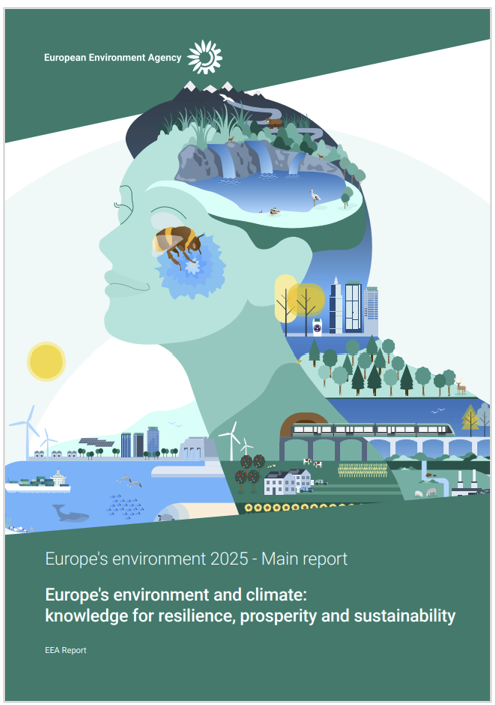
Europe's environment 2025 / EEA 29 Sept. 2025 - 7th Ed. 1995 - 2025
ID 24811 | 27.10.2025 / Attached
Knowledge for resilience, prosperity and sustainability
Every five years, as mandated in its founding regulation, the European Environment Agency (EEA) publishes a state of the environment report. Europe's environment 2025 provides decision makers at European and national levels as well as the general public with a comprehensive and cross-cutting assessment on environment, climate and sustainability in Europe.
Europe's environment 2025 is the 7th state of the environment report published by the EEA since 1995.
Europe's environment 2025 has been prepared in close collaboration with the EEA’s European Environment Information and Observation Network (Eionet). The report draws on the Eionet’s vast expertise of leading experts and scientists in the environmental field, across the EEA’s 32 member countries and six cooperating countries.
[box-note]Italy
The Italy country profile provides a concise overview of key trends across three dimensions: environment and climate; socio-economic change; and system change (energy, mobility and food) in the country. It highlights the main developments and challenges in these areas, including measures to support progress towards sustainability in Italy. An assessment for each of the three dimensions was prepared by national experts from the European Environment Information and Observation Network (Eionet) in Italy, based on 20 established indicators from the EEA or Eurostat.
Italy is making significant strides towards sustainability but faces many challenges. Italy has excelled in organic farming. Protected areas cover 21.7% of the territory; however, Italy needs to increase this share to contribute to achieving the EU target of 30% by 2030. Greenhouse gas (GHG) emissions have decreased since 2005, but further reductions are needed to meet EU targets. Renewable energy is a key opportunity, with Italy surpassing its 2020 target and aiming for 38.7% renewable energy use by 2030. Although energy consumption has decreased, the reduction rate must be doubled to meet future targets. Climate-related economic losses are increasing, highlighting the need for robust adaptation strategies. Waste management and circular economy practices require improvement.
Italy faces socioeconomic challenges, including a widening generational economic gap, poor social mobility and significant energy poverty, affecting millions of households. Structural reforms and investments (e.g. Italy’s national recovery and resilience plan) aim to address these issues through furthering sustainable prosperity and competitiveness, digitalisation and innovation. The interaction between social, environmental and economic challenges is addressed within the national sustainable development strategy, which incorporates the 2030 agenda and its sustainable development goals for Italy, while also aligning with the objectives of the national recovery and resilience plan. The national sustainable development strategy is the reference framework for maintaining coherent national sustainable development policies through the annual monitoring the 55 most representative indicators.[/box-note]
European Environment Agency (EEA)

Magneto
Author’s Posts
-
Atti del seminario nazionale avvocati Inail
Circolare MIT Prot. n. 28501 del 10.10.2025
Circolare MIT Prot. n. 28501 del 10.10.2025
ID 24979 | 25.11.2025
Ch...
تشرين2 25, 2025
-
Nota MIT Prot. n. 20678 del 18 luglio 2025
Nota MIT Prot. n. 20678 del 18 luglio 2025
ID 24976 | 25.11.2025
Not...
تشرين2 25, 2025
-
UNI 11997:2025 | End of waste: Sabbia di vetro
تشرين2 25, 2025
-
ADR 2027 Draft amendments to annexes A and B | WP 118th Sess. November 2025


News
Food
Politics
Technology
About Us
Download Our Mobile App